
Contact Us
Landfill Fees
Remediation
Medication Disposal
Recycling
Bannock County Solid Waste Division (Landfill)
Fort Hall Mine Landfill
Pocatello, ID 83204
Google Map
Phone: 208-236-0607
Hours:
Monday – Saturday
7 a.m. – 5 p.m.
Closed Federal Holidays
McCammon Transfer Station
McCammon, ID, 83250
Open Saturdays
8:00 a.m. – 4:00 p.m.
Closed Federal Holidays
Fort Hall Mine Landfill Fees: |
McCammon Transfer Station Fees: |
| We accept Cash, Check, or Cards* *$2.00 fee per transaction for debit or credit |
We accept Cash or Checks. Cards are not accepted at the McCammon location. |
|
Cells 2 & 4: Household waste or items that might decompose and harm our aquifer. Cell 3: All construction and demolition materials, such as roofing, wood waste, and concrete. Household waste:
Construction waste:
Other materials:
Tires:
Asbestos:
No charge for topsoils/clean dirt – Must call ahead for inspection and analysis instructions. |
Vehicles:
Other materials:
Tires:
$10.00 fee for all unsecured loads ITEMS NOT ACCEPTED AT THE MCCAMMON LOCATION:
|
Household Hazardous Waste
The Fort Hall Mine Landfill in Pocatello collects Household Hazardous Waste for free from April through October on the first Saturday of each month from 9 a.m. to 3 p.m. County residents can bring their waste to the landfill’s household hazardous waste building for drop-off (or they will be directed by employees who remove the waste from the vehicles).
2025 Hazardous Waste Collected:
- 4,037 gallons of used oil
- 4,500 pounds of pesticides & herbicides
- 1,323 fluorescent lightbulbs
- 1,733 gallons aerosols
- 1,521 gallons of flammable liquid & sludge
- 2,400 gallons latex
- 1,123 gallons antifreeze
2026 Household Hazardous Waste Days:
- April 4 | May 2 | June 6 | NO JULY DATE (due to holiday) | August 1 | September 5 | October 3
- From 9:00 a.m. – 3:00 p.m.
The following materials are currently accepted on Household Hazardous Waste Days:
From your workbench:
|
From your garbage:
|
From your yard:
|
From your house:
|
Free Days at the Fort Hall Mine Landfill
Bannock County offers Free Days at the Fort Hall Mine Landfill to all county residents on certain days of the year.
2026 Free Days | May 16, July 18, October 17
Free Dumpster Days in Southern Bannock County
Bannock County has partnered with PSI Waste Systems and the cities of Arimo, Downey, Lava Hot Springs, and McCammon to offer Free Dumpster Days during the summer.
More Information
Restricted items not included in any Free Days:
- Chemicals – of any kind or form
- Liquids
- Tires
- Batteries – of any kind
- Appliances – fridge, freezer, a/c, water cooler, ice maker, stove, water heater, washer, dryers, etc.
Free Days are offered to residents only and are not available for businesses and organizations.
Hazardous waste is accepted at the Fort Hall Mine Landfill ONLY on the first Saturday of April through October from 9:00 a.m. – 3:00 p.m.
Loads must be secured.
Free Recycling
Bannock County Solid Waste offers free drop-off recycling for residents to help reduce the amount of waste that ends up in the landfill.
Drop-off Locations:
Fort Hall Mine Landfill (bins located behind the office building)
McCammon Transfer Station
Acceptable Recyclable Material: |
Items NOT Accepted: |
|
|
For questions about what material is accepted, please call 208-236-0607.
About the recycling program:
- Certain plastics are accepted at the City of Pocatello’s Recycling Center.
- Plastic items labeled #1 and #2, as well as #5 food tubs (like those used for cottage cheese, sour cream, yogurt, or butter), are accepted at the City of Pocatello Recycling Center at 3034 Garrett Way.
- Other local recycling resources
Asbestos
Asbestos is accepted at the Fort Hall Mine Landfill. The McCammon Transfer Station does not accept asbestos. In order to comply with EPA standards, the following conditions must be met:
- Asbestos must be properly contained
- Friable asbestos must be contained in twelve-mil plastic (double-wrapped or bagged in six-mil plastic is standard practice), wetted, and properly labeled.
- Non-Friable Asbestos must be contained in twelve-mil plastic (double-wrapped or bagged in six-mil plastic is standard practice) and properly labeled.
- Manifest must be complete and handed to the scale house attendant upon arrival at the landfill.
- The asbestos must be placed where directed by Landfill personnel.
- All roofing will be treated and charged as construction debris.
- Any structure built before 1979 will be treated and charged as asbestos.
- OSHA or EPA-approved warning labels must be permanently marked or attached to plastic wrapping.
Fees:
$120 per ton for Bannock County Residents
$185 per ton for out-of-county residents
Batteries
Vehicle batteries are accepted at both the Fort Hall Mine and the McCammon Transfer Station. All other household batteries are accepted at no charge on our household hazardous waste days. Household Hazardous Waste days are the first Saturday of each month, April through October, from 9 a.m. to 3 p.m. All rechargeable batteries will be accepted at Fort Hall Mine Landfill at no charge during regular hours.
Construction and Demolition Debris
Construction and Demolition Debris
Construction and demolition debris (C&D) is accepted at both the Fort Hall Mine Landfill and the McCammon Transfer Station. C&D is an inert material and can be disposed of at a much lower rate than municipal solid waste (MSW). It is up to the customer to meet our acceptance criteria, and loads are subject to random load inspections. In order for waste to be accepted as C&D, it must meet these requirements:
- C&D waste consists of:
- Construction/Demolition debris
- Cured asphalt and concrete rubble
- Masonry rubble
- Uncontaminated soils, rock, gravel, or dirt fill
- Bulky wood wastes, stumps, branches, or limbs
- Scrap metals, fencing, wire, poles, or boards
- Dead animals (Fort Hall Mine Landfill only)
- Asbestos (Fort Hall Mine Landfill only)
- Waste must contain no more than 10% organic materials, household waste, carpet, and plastics.
- Waste must not contain any hazardous waste.
- Any load that is redirected will be subject to the appropriate MSW tipping fee.
Dead Animals
Dead animals are accepted at the Fort Hall Mine Landfill only.
Fees:
$29.00 per ton
Drums
Drums are accepted at both the Fort Hall Mine landfill and McCammon Transfer Station. A drum is a cylindrical container made of steel or plastics that is used for shipping bulk materials. Drums are generally used in commercial and industrial applications for the transportation of hazardous waste; therefore, in order for Bannock County to accept drums, they must meet these requirements:
- Drums must be emptied, rinsed, and residue-free.
- The rinsed drums must then have lids off and/or holes punctured in both ends.
- All drums will be inspected for hazardous waste.
Electronic Waste
Electronic waste (E-Waste) is accepted at Fort Hall Mine Landfill free of charge. E-waste is not accepted at the McCammon Transfer Station.
Acceptable E-Waste:
- Computer towers
- Flat screen tv’s and monitors
- Rechargeable batteries
- Cell phones
- Laptops
- Home electronics (cable boxes, sound systems, DVD players, RCA, satellite boxes)
- Solar products
There is a charge for Cathode Ray Tube (CRT) monitors and televisions. The CRT monitor is the older, larger, and heavier version of the LCD monitor with a bowl-shaped screen made of glass.
Household Hazardous Waste
Household hazardous waste (HHW) is accepted at the Fort Hall Mine Landfill every first Saturday, April through October, from 9 a.m. to 3 p.m. Acceptance is dependent on the review of source and generation information. Bannock County has the right to refuse loads and/or require additional testing. Loads are also subject to random load inspections.
Acceptable Types of HHW:
- Used motor oil –5 gallons maximum container size. Acceptable in unmarked containers and must be transferred without spilling.
- Antifreeze. Acceptable in unmarked containers and must be transferred without spilling.
- Flammable and Combustible Liquids – 5 gallons maximum container size. It must be in the original sealed container.
- Batteries – Alkaline, Nickel-Cadmium (Ni-Cd), Lithium-Ion (Li-ion), Nickel-Metal-Hydride (Ni-MH), small sealed lead (Pb), Automotive batteries.
- Corrosives – Must be less than 2 gallons to accept.
- Pesticide, Herbicide, or Fertilizer – 5 gallons maximum container size. It must be in the original sealed container.
- Mercury – Thermometers, thermostats, and elemental mercury (small containers) are accepted in our HHW program.
*We do not limit the HHW diversion program to these items*
Visit the ‘Household Hazardous Waste’ tab on this page to view the full list of acceptable HHW.
Household Liquid Waste
The Fort Hall Mine Landfill accepts liquid waste only from Bingham County’s Central Transfer Station. Liquid waste from businesses or residents is not accepted. Acceptable liquid waste is limited to household waste collected in the drainage tank as part of normal solid waste transfer. No other sources of liquid waste are to be transferred or accepted. Requirements for acceptance of this waste are:
- Bingham County must utilize a dedicated, marked tanker and county personnel to transfer the liquid to Bannock County. No outside contractors or pumper trucks are to be used. Bingham County is responsible for compliance with all federal, state, and local transportation regulations.
- Bingham County will supply a manifest of waste to the Fort Hall Mine Landfill scale house upon delivery. The log will include the date of transfer, quantity of liquid, and name and signature of personnel providing the documentation. This log will be placed into Bannock County’s permanent operating record.
Liquid waste will be placed directly into the lined leachate collection pond at the Fort Hall Mine Landfill. Liquid waste will not be placed in any other location, including the operating landfill cell.
Mercury
The Fort Hall Mine Landfill accepts thermometers, thermostats, and small amounts of elemental mercury for free on the designated Household Hazardous Waste days. In order to protect the safety of our personnel, please follow these instructions:
- All mercury should be secured in cardboard, bubble wrap, or some other reasonable type of protection.
- Thermometers with blue or red liquid inside do not contain mercury and can be thrown away with regular trash.
- All fluorescent bulbs containing mercury should be secured to protect them from breakage. Non-fluorescent bulbs can be discarded in regular trash containers.
Petroleum Contaminated Soils
The Fort Hall Mine Landfill accepts petroleum-contaminated soil (PCS). PCS is not accepted at the McCammon Transfer Station.
Acceptance is on a case-by-case basis dependent on verifying the source of the release and a review of lab data which is representative of the PCS and that it meets applicable acceptance criteria.
PCS Generated as the Result of Spills & Accidents
Where the source of petroleum is known and is only contaminated by soil, and no other chemical contaminants, the following acceptance criteria shall apply:
| Petroleum Type | Laboratory Analysis Required | Acceptance Criteria |
| Gasoline PCS | TPH 8015, Gasoline Range Organics, flashpoint |
100 mg/kg (ppm) or less |
| JP-4 (Jet A Fuel) | TPH 8015, Gasoline Range Organics, flashpoint |
100 mg/kg (ppm) or less |
| Diesel PCS | TPH 8015, Diesel Range Organics, flashpoint |
3,000 mg/kg (ppm) or less |
| Heating, Motor, and Lube Oil PCS | TPH 8015, Extended Range Organics, flashpoint |
3,000 mg/kg (ppm) or less |
| Hydraulic Fluid/Mineral Oil PCS | TPH 8015 | 3,000 mg/kg (ppm) or less |
Unknown Sources of PCS
Other sources of PCS must be characterized to document that it does not meet the definition of hazardous waste.
In order to comply with the Resource Conservation Recovery Act (RCRA) 40 CFR 261.31-33, lab analyses of representative samples of the PCS from the sources listed below must be provided. Possible constituents of concern include heavy metals, chlorinated solvents, and pesticides. Reported laboratory concentrations must be screened against EPA’s Table 1 Maximum Concentration of Contaminants for the Toxicity Characteristic (40 CFR 261.24).
| Source | Laboratory Analysis Required | Acceptance Criteria |
| Used Oil PCS | TPH 8015, Extended Range Organics & flashpoint TCLP 1311 for RCRA 8 metals TCLP 8260 for volatile organic compounds |
3,000 mg/kg (ppm) or less |
| Unknown Source of PCS | TCLP 1311 for RCRA 8 metals TCLP 8260 for volatile organic compounds TCLP 8270C for semi-volatile organic compounds TCLP 8081 for chlorinated pesticides TCLP 8151A for chlorinated herbicides TPH 8015 MOD, GRO, DRO, ORO & flashpoint |
3,000 mg/kg (ppm) or less |
Additional Criteria
- All appropriate source information and lab work must be submitted to the Fort Hall Mind Landfill for review prior to shipment. If the PCS is accepted, landfill staff must be notified at least 12 hours prior to shipment.
- Landfill personnel have the right to refuse loads and/or require additional testing. Loads are also subject to random load inspections.
- Polychlorinated Biphenyl (PCB) wastes are not accepted.
- All PCS from any source must also meet the paint filter test.
- Each load must be accompanied by a signed Waste Tracking/Source Profile Form.
- PCS must be placed where directed by landfill personnel.
- Street Sweepings, Storm Water Sediments, and other inert material that may have incidental contact with petroleum products and other organic material is acceptable as long as the generator can certify that the generation of such solid waste was not the result of the clean-up petroleum spills. If the material was generated as the result of a petroleum spill, then the PCS acceptance criteria shall apply.
Syringes
The Fort Hall Mine Landfill accepts the disposal of household needles and syringes. In order to protect the safety of our personnel, please follow these instructions:
- Used needles and syringes should be placed in a puncture-proof, leak-proof container with a tight-fitting lid. Appropriate containers include red sharps containers (available from most pharmacies at a cost of $3-$5) or a heavy plastic bottle (such as a laundry detergent bottle).
- Bleach or another disinfecting solution should be added.
- When the container is full, make sure the lid is on tight, and apply heavy tape (duct tape or packaging tape) to ensure that the lid remains sealed.
- The sealed container can be put in your garbage container or brought to the landfill.
Trailer Home Disposal
Trailer Homes, or mobile homes, are accepted at the Fort Hall Mine Landfill only, under these conditions:
- Verification of refrigerant removal prior to arrival at the landfill
- Proof from the Assessor or Treasurer’s Office that taxes have been paid. (If disposing on Saturday, ALL documentation must be in hand. Assessor and Treasurer’s Offices are closed on Saturdays.)
- Tires will be removed at the disposal area (If disposing of tires, they will need to go to the appropriate location with a fee).
If a trailer home is too large to fit on the scale, a flat rate charge of $375 will be assessed.
Wastewater Treatment Plant Sludge
24-HOUR NOTICE REQUIRED – FAILURE TO COMPLETE ALL REQUIREMENTS MAY RESULT IN LOAD REFUSAL
Bannock County accepts Bio-solids at the Fort Hall Mine Landfill. Acceptance is dependent on the review of source and lab data which is representative of the Bio-solids. All appropriate source information and lab work must be submitted to landfill personnel for review prior to shipment. A certified lab analysis is good for 12 months from the date it was tested. Bannock County has the right to refuse loads and/or require additional testing. Loads are also subject to random load inspections.
- In order to comply with R.C.R.A 40 CFR Part 261.3, the following lab analyses from an approved
laboratory are required to characterize the waste:- Toxicity Characteristics Leaching Procedure (TCLP)-R.C.R.A 8 Metals
- pH Test
- Paint Filter Test
- If Bio-solids are accepted, Bannock County must be notified at least 24 hours prior to shipment.
- Each load or series of loads must also be accompanied by a signed Waste Tracking/Source Profile Form.
- Bio-solids must be placed where directed by landfill personnel
Compost is sold Monday through Saturday from 7:00 a.m. to 5:00 p.m. The cost is $35 per ton.
*Compost is currently sold out – April 14, 2025. More compost may be ready by June 2025. Check back here for updates.
The compost is locally sourced through the Pocatello Yard Waste and Curbside Leaf Collection programs and individual disposals of yard and compostable waste.
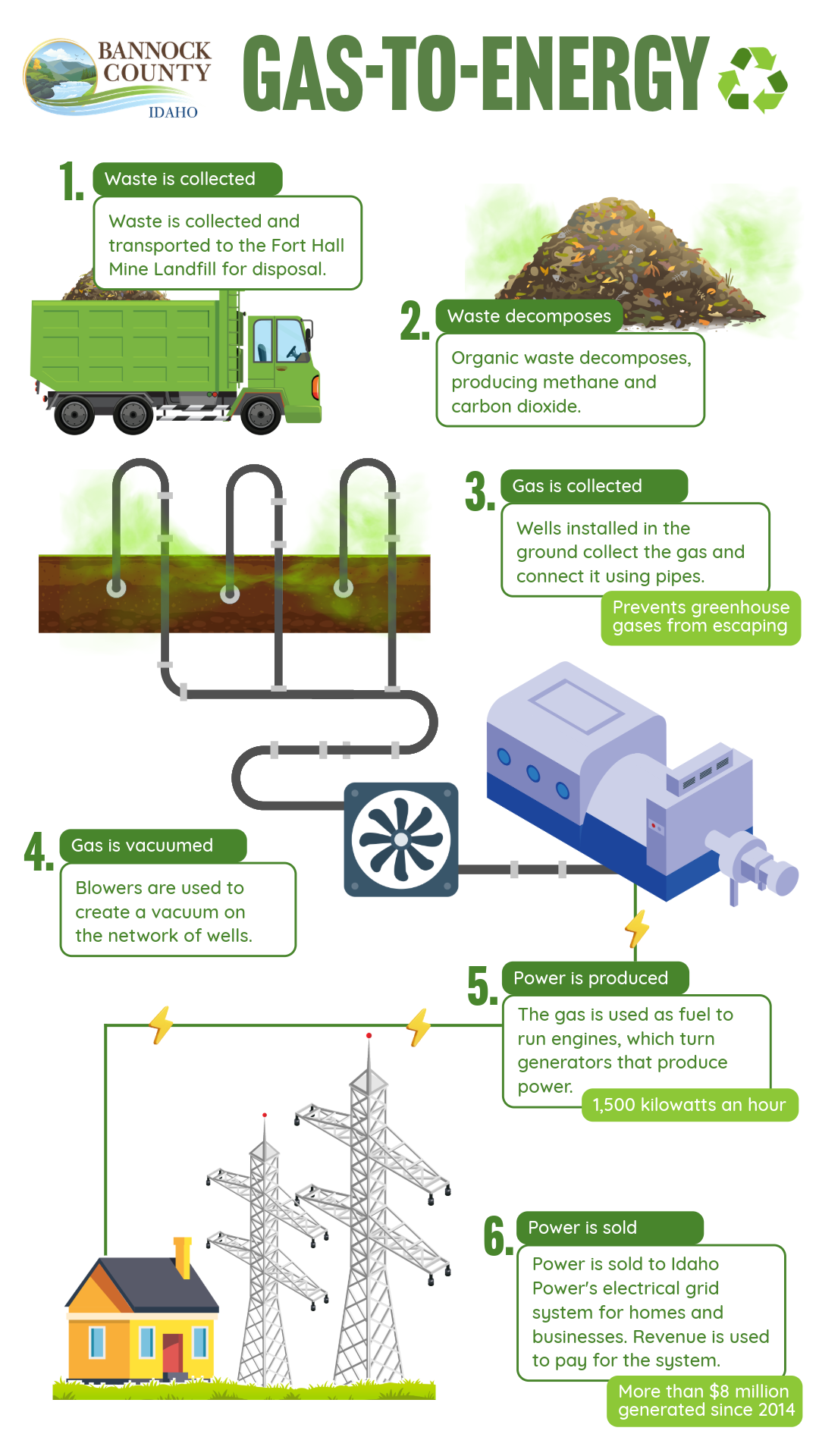
Gas-to-Energy Program
Bannock County utilizes an innovative gas-to-energy system at the Fort Hall Mine Landfill to convert byproduct gases into renewable electricity. This project represents one of only four methane gas-to-energy systems in the state of Idaho, positioning the county as a leader in regional sustainable waste management.
The Science of Resource Recovery
As organic waste decomposes within a landfill, it naturally generates landfill gas. If left unmanaged, this gas—primarily methane—escapes into the atmosphere. To prevent this, the Fort Hall Mine Landfill utilizes a sophisticated collection network:
-
Extraction: A network of 48 wells is integrated into the waste mass across Cells 1, 2, and 4.
-
Collection: Industrial blowers create a vacuum to draw the gas through a piping system, ensuring it is contained rather than released.
-
Conversion: The captured gas serves as fuel for specialized engines that drive generators, converting a waste byproduct into a stable source of power for the electrical grid.
Environmental Impact and Innovation
The primary benefit of this system is the mitigation of greenhouse gases. Methane has a global warming potential 20 times higher than carbon dioxide. By capturing and burning this gas for energy, the facility significantly reduces the landfill's carbon footprint.
Currently, the landfill produces less than 25 metric tons of Non-Methane Organic Compound (NMOC) emissions—remaining well below the updated EPA threshold of 34 metric tons. This proactive approach ensures the facility exceeds federal environmental standards while contributing to a circular economy.
Performance and Grid Integration
The project operates in partnership with Idaho Power through a 20-year power purchase agreement. Key performance metrics include:
|
Grid Contribution |
System generates approximately 1,500 kilowatts per hour, sufficient to power 1,000 homes simultaneously. |
|
Operational Scale |
The system runs 24/7; a second generator added in 2019 has already produced over 48,000 mWh. |
|
Return on Investment |
Since implementing the system in April 2014, the system has generated more than $8.4 million in electricity. Revenue from energy production is structured to offset the costs of the gas extraction system over the life of the contract. |
Through this facility, Bannock County demonstrates a commitment to innovative infrastructure, turning an environmental challenge into a consistent source of renewable energy for Idaho residents.
Fort Hall Mine Landfill Groundwater Remediation
The County closed Cell 1 and began investigating ways to remedy the contamination. In 2002, the County installed a groundwater remediation system to remove chemicals of potential concern, but ongoing studies have shown that has not prevented chemicals from impacting the Lower Portneuf Valley Aquifer, which supplies drinking water to most Bannock County residents.
In order to mitigate the problem, the Bannock County Solid Waste Division partnered with CDM Smith, a private engineering and construction firm, to monitor the contamination and provide recommendations for actions the County can take.
Since 2018 alone, Bannock County has committed $10 million to this ongoing study and remediation project. With the help of CDM Smith, crews have begun monitoring dozens of offsite wells for contamination, investigating to determine which ground layers contaminants are moving through, and monitoring the protective cover of Cell 1.
According to CDM Smith’s 2020 risk assessment, seven domestic wells may be unsafe to drink, and the property owners and tenants affected were notified. However, for the majority of people in the surrounding area, private well water is safe to drink.
Learn more about the health risks and what prevention and remediation efforts the County has taken to protect residents’ drinking water by visiting the links below.
What We Do
Part of this great expense was a specially designed liner that protects the environment by keeping the leachate from further contaminating the groundwater. Household debris is covered daily with tarps designed for landfills and soil to prevent garbage from being exposed to vectors, wind, and the atmosphere. We accept approximately 300 tons of waste per day, up from an average of 230 tons per day in 1993. We operate both the Fort Hall Mine Landfill in Pocatello and the transfer station in McCammon with only thirteen employees.
Fort Hall Mine Landfill
Location:
1500 N Fort Hall Mine Rd
Pocatello, ID 83204
Phone: 208-236-0607
Hours: Monday – Saturday
7:00 am – 5:00 pm
Closed Sundays and all Federal Holidays
McCammon Transfer Station
2687 McCammon Landfill Road
McCammon, ID 83250
Hours:
Open Saturdays 8:00 a.m. – 4:00 p.m.
Landfill Staff

